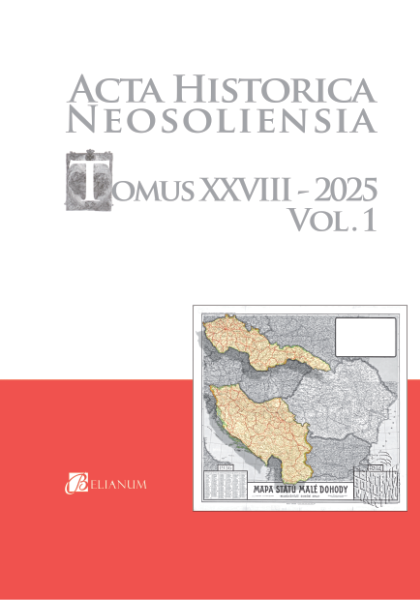
Tomus 28, num. 1 – DVOŘÁKOVÁ, D. – HLAVAČKOVÁ, M.: Archivárky na cestách. Keď sa história meria v kilometroch. Budmerice : Vydavateľstvo Rak, 2025. (P. Molnárová)

DVOŘÁKOVÁ, Daniela – HLAVAČKOVÁ, Miriam: Archivárky na cestách. Keď sa história meria v kilometroch. Budmerice : Vydavateľstvo Rak, 2025. 222 s. ISBN 978-80-85501-96-4 (P. Molnárová)

Archív

Úplné textové verzie vo formáte PDF

Tomus 28, num. 1 – Správa z medzinárodnej vedeckej konferencie „Vojenské a vojensko-politické spojenectvá v moderných a súčasných dejinách strednej Európy: prednosti, limity, výzvy“. Vojenský historický ústav Praha, 19. – 21. marca 2025 (F. Jakab)

Správa z medzinárodnej vedeckej konferencie „Vojenské a vojensko-politické spojenectvá v moderných a súčasných dejinách strednej Európy: prednosti, limity, výzvy“. Vojenský historický ústav Praha, 19. – 21. marca 2025 (F. Jakab)

Archív

Úplné textové verzie vo formáte PDF

Tomus 28, num. 1 – Prof. PhDr. Karol Fremal, CSc. (22. október 1943, Kremnica – 26. február 2025, Banská Bystrica) (M. Syrný)

Prof. PhDr. Karol Fremal, CSc (22. október 1943, Kremnica – 26. február 2025, Banská Bystrica) (M. Syrný)

Archív

Úplné textové verzie vo formáte PDF

Tomus 28, num. 1 – LAZNIOVÁ, M.: Dobovou tlačou publikované príspevky G. F. Berzeviczyho o splavovaní riek v rokoch 1807 a 1812

Dobovou tlačou publikované príspevky G. F. Berzeviczyho o splavovaní riek v rokoch 1807 a 1812

MIROSLAVA LAZNIOVÁ
Múzeum Spiša v Spišskej Novej Vsi

Contemporary press articles about river rafting written by G. F. Berzeviczy between 1807 and 1812

Abstract: Gregor F. Berzeviczy had personal experience of navigating rivers on the route from Spiš to Gdańsk. Less well known, however, are his water journeys on Slovak rivers, the aim of which was to verify the possibilities of transporting goods by water. The aim of this article is to offer Slovak readers a collection of Berzeviczy’s reports, which were published in the press in 1807 and 1812. These short articles present his practical experiences with navigating some Hungarian rivers, which he also discussed in greater detail in his economic writings. Berzeviczy’s notes were published in the periodical Vaterländische Blätter für den austrian Kaiserstaat in August 1808 and January 1813, and later again in 1821 in Topographisch-statistisches Archiv des Königreichs Ungern. While in his first post he described his journey by water to Poland along the Poprad, Dunajec, and Vistula rivers, in his second post he recounted his journey along the Váh River. These short articles published by Berzeviczy are a great example of his determination and also proof that his scientific writings are based on empirical experience. From a historiographical point of view, the articles are a valuable fragment of information for research into rafting in the area of today’s Slovak-Polish border and on the Váh River.

Keywords: river rafting, Hungarian rivers, transportation of goods, trading route.

Archív

Úplné textové verzie vo formáte PDF

Tomus 28, num. 1 – LACKO, M.: Ľupčiansky hrad v polovici 16. storočia vo svetle najstaršieho zachovaného inventára

Ľupčiansky hrad v polovici 16. storočia vo svetle najstaršieho zachovaného inventára

MIROSLAV LACKO
Friedrich-Christian-Lesser-Kolleg für Ostmitteleuropa, Friedrich-Schiller-Universität, Jena, Nemecko

Ľupča Castle in the Mid-Sixteenth Century in the Light of Oldest Preserved Inventory

Abstract: From 1527, the Ľupča Castle was possessed by Mary of Austria (1505 – 1558), the dowager-queen of Hungary that kept the Lower Hungarian minting chamber in Kremnica with several estates and castles in this area (present-day Central Slovakia) after the death of her husband King Louis II (1506 – 1526) during the battle of Mohács. As Maria had become governor of the Habsburg Netherlands in 1531, her brother, the new Hungarian King Ferdinand I (1503 – 1564), began to aim at an assumption of her Lower Hungarian property to the royal government, because this mining area represented a very important source of finance. After long-term efforts, the contract about a financial compensation between the King Ferdinand I and his sister Mary was made on 7 March 1548 in Augsburg and by this contract, Mary renounced her claim for the Lower Hungarian minting chamber, estates and castles Ľupča, Vígľaš, and Dobrá Niva in favour of Ferdinand I. Until the end of August 1548, these estates and castles were assumed to the royal ownership. Thereat, the oldest known inventory of the Ľupča Castle was elaborated by the royal commissioners on 30 August 1548 and its exact transcription is published in the appendix of this study for the first time.

Keywords: Ľupča, castle, inventory, material culture, Hungary, Central Slovakia, Habsburg policy.

Archív

Úplné textové verzie vo formáte PDF

Tomus 28, num. 1 – JAKAB, F.: Politické vzťahy medzi Československom a Juhosláviou v období diktatúry (1929 – 1934): Interakcie v diplomatickom segmente

Politické vzťahy medzi Československom a Juhosláviou v období diktatúry (1929 – 1934): Interakcie v diplomatickom segmente

FRANTIŠEK JAKAB
Katedra histórie, Filozofická fakulta, Univerzita Mateja Bela v Banskej Bystrici

Political Relations between Czechoslovakia and Yugoslavia during the Dictatorship (1929–1934): Interactions in the Diplomatic Segment

Abstract: In 1929, internal political conflicts and numerous crises in Yugoslavia culminated in a regime change and the proclamation of a dictatorship. The study closely examines the development of bilateral political and diplomatic relations between autocratic Yugoslavia and democratically oriented Czechoslovak Republic, which at the time was its closest ally. The author further analyzes the attitude and behavior of Belgrade toward Prague, which, in order to maintain the alliance, was willing to make concessions and tolerate the authoritarian regime. Throughout the nearly six-year existence of the Yugoslav dictatorship, the country experienced significant repression and a dramatic curtailment of both personal and public freedoms, leaving a deep mark on Yugoslav society. While parts of the Czechoslovak political scene – and especially the press – critically reflected on the actions of the Yugoslav government against its own population, the official position of the Czechoslovak state remained unchanged. The study also partially focuses on the activities of the Yugoslav opposition and the Czechoslovak press, which did not always share the official narrative promoted by Prague. Despite its continued support for the dictatorship, Czechoslovakia failed to deepen its relations with Belgrade. On the contrary, relations gradually cooled during the 1930s, ultimately culminating in Yugoslavia’s passive stance toward the fate of Czechoslovakia during the Munich crisis of 1938.

Keywords: Czechoslovakia, Yugoslavia, interwar period, dictatorship, diplomacy, political relations.

Archív

Úplné textové verzie vo formáte PDF

Tomus 28, num. 1 – MARČOKOVÁ, D.: Slovenský evanjelický cirkevný zbor v Hajdušici v zápisniciach z kanonických vizitácií z rokov 1836 a 1887

Slovenský evanjelický cirkevný zbor v Hajdušici v zápisniciach z kanonických vizitácií z rokov 1836 a 1887

DANIELA MARČOKOVÁ
Oddelenie slovakistiky Filozofickej fakulty Univerzity v Novom Sade, Srbsko

Slovak evangelical congregation in Hajdušica in the returnes of the ecclesiastical visitations in the years 1836 and 1887

Abstract: The evangelical congregations in Bačka and in Srem were visited for the first time in 1789. The later returns from the visitations in 1810 and 1818 are mostly not preserved in the Slovak church congregations in Vojvodina, while the visitation returns of the Slovak Evangelical congregations in Bačka, Srem and Banat in 1835 and 1836 are digitized and available. In this work, we deal with the research of the visitation records of the evangelical church congregation in Hajdušica, belonging to the Banat seniorate, which was part of the Banský dištrikt/superintendancy with its headquarters in Banská Bystrica. The first Slovak Evangelicals immigrated to Hajdušica in 1824 from the Nitra County. A significant number of Slovaks immigrated from Padina in 1826. Until 1829, Slovak evangelicals from Hajdušica belonged to the Padina church congregation and then became independent. The first canonical visitation in the Hajdušica church congregation was conducted by superintendent Ján Seberíni in 1836. The returnes of this visitation were written in Latin. The ecclesiastical visitation in 1887 was conducted by superintendent Gustáv Seberíni. These second examined returns were written in contemporary Slovak. Through these returns from ecclesiastical visitations made by church dignitaries, father and son, we follow the development of the evangelical congregation in Hajdušica over a span of 50 years. We also used other relevant literature to supplement some facts.

Keywords: Evangelical Church of the Augsburg Confession, Slovaks, Banský dištrikt/superintendancy, Banat Seniorat, Hajdušica, ecclesiastical visitations 1836 and 1887.

Archív

Úplné textové verzie vo formáte PDF