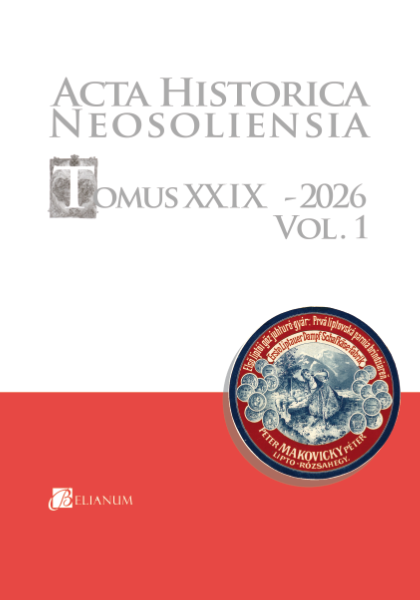
Tomus 29, num. 1 – ŠIMON, F. – BALEGOVÁ, J.: Matej Bel: O banskobystrických medených vodách. Košice : UPJŠ, 2024. (V. Wintner)

ŠIMON, František – BALEGOVÁ, Jana: Matej Bel: O banskobystrických medených vodách. Košice : UPJŠ, 2024. 144 s. ISBN 978-80-574-0286-2 (V. Wintner)

Archív

Úplné textové verzie vo formáte PDF

Tomus 29, num. 1 – AMIR, A.: História a kultúra Ukrajiny I. / Історія та культура України I. Prešov : Vydavateľstvo Prešovskej univerzity, 2025. (M. Šmigeľ)

AMIR, A.: História a kultúra Ukrajiny I. / Історія та культура України I.
Prešov : Vydavateľstvo Prešovskej univerzity, 2025. (M. Šmigeľ)

Archív

Úplné textové verzie vo formáte PDF

Tomus 29, num. 1 – ANDERKOVÁ, A. – PASTIRIKOVÁ, I. – ŠMECKOVÁ, J. – ŠTRBKOVÁ, D.: Dejepis pod lupou 1. Učebnica pre stredné školy a gymnáziá. Košice : Taktik, 2026. (P. Molnárová)

ANDERKOVÁ, Anna – PASTIRIKOVÁ, Ivana – ŠMECKOVÁ, Jarmila – ŠTRBKOVÁ, Denisa: Dejepis pod lupou 1. Učebnica pre stredné školy a gymnáziá. Košice : Taktik, 2026. 136 s. ISBN 978-80-8180-858-6 (P. Molnárová)

Archív

Úplné textové verzie vo formáte PDF

Tomus 29, num. 1 – Výskum historického myslenia a historického bádania Františka Víťazoslava Sasinka s využitím prístupov Digital humanities (Z. Kudzbelová)

Výskum historického myslenia a historického bádania Františka Víťazoslava Sasinka s využitím prístupov Digital humanities (Z. Kudzbelová)

Archív

Úplné textové verzie vo formáte PDF

Tomus 29, num. 1 – BRUJA, R. F.: The First Romanian-Slovak Economic Contacts and Their Difficulties (March – December 1939)

The First Romanian-Slovak Economic Contacts and Their Difficulties (March – December 1939)

RADU FLORIAN BRUJA
Ştefan cel Mare University of Suceava, Romania

Abstract: The commercial relations that Romania had with the Axis satellites at the beginning of World War II have escaped the attention of researchers, the rapprochement between Romania and the Slovak Republic being nearly unknown. The examined states had different internal political systems, traditions and tendencies. Slovakia was born with the illusion of independence, finding itself from the beginning in the sphere of interests of the Third Reich. Romania swung between the England and France on one side and the Nazi Germany on the other during this period. Since there was no compatibility between Romania and Slovakia in 1939, economic relations developed slowly. Although a legacy of the old Czechoslovakia, economic relations represented the first signs of rapprochement between Bucharest and Bratislava, preparing the cooperation of later times. The analysis we propose is opened by the first economic contacts between the two countries during the period when political relations between Bucharest and Bratislava were limited to mere tentativeness. Romanian historiography has neglected the subject of Romanian-Slovak relations, only tangentially touching on the issue of bilateral relations between Romania and the first Slovak Republic. By contrast, Slovak historiography paid attention to the economic situation of the new state and its economic relations with Czechoslovakia’s old partners, including Romania. The establishment of bilateral diplomatic relations was favoured precisely by these economic ties. The need to develop economic relations between Romania and Slovakia was materialized in the Economic Agreement of December 1939, which we have under scrutiny in our analysis. The Agreement of December 1939 laid the foundations of trade between the two countries. It mainly concerned Slovak armament and Romanian oil. Economic relations between Slovakia and Romania developed under the conditions of the Bucharest-Prague-Bratislava trilateral trade and the domination exercised by Germany. The economic implications of this approach represent the focal point of our study.

Keywords: Slovakia, Romania, German Reich (Nazi Germany), Protectorate of Bohemia and Moravia, economical relations, commercial conventions, military equipment, oil production.

Archív

Úplné textové verzie vo formáte PDF

Tomus 29, num. 1 – HARVAN, D. – MARGÓTSYOVÁ, V.: Kachelmannova strojáreň a zlievareň medzi rokmi 1921 – 1931 v spomienkach Ing. Ladislava Margótsyho

Kachelmannova strojáreň a zlievareň medzi rokmi 1921 – 1931 v spomienkach Ing. Ladislava Margótsyho

DANIEL HARVAN – VERONIKA MARGÓTSYOVÁ
Slovenské banské múzeum, Banská Štiavnica – privátna bádateľka

Kachelmann’s machine factory and foundry between 1921 – 1931 in the memories of Ing. Ladislav Margótsy

Abstract: In the article, we pay attention to the company Karol Kachelmann and Son, a machine factory and foundry in Vyhne, during the period when its co-owner was Karol Kachelmann III. – the last representative of the Kachelmann family interested in managing family businesses in Vyhne. Specifically, we focus on the period from 1921 to 1931 and the issue of the development of the company from the perspective of its technical employee – mechanical engineer Ladislav Margótsy, who worked in the factory´s engineering and foundry for ten years. After retirement, he began recording his memories and processing his family history in the form of a chronicle. The information from it is today a testimony to us about its author – the writer – and the time in which he lived. They help us complete the mosaic of knowledge of regional history. Unlike archival documents, chronicles also tell us about various, often interesting circumstances leading to the decisions of the actors in the events. They also tell us about their feelings, which we cannot find in official documents. Therefore, chronicles are an interesting source of information, along with other sources.

Keywords: Vyhne, Kachelmann’s machine factory and foundry, economic crisis, Ladislav Margótsy, Banská Štiavnica.

Archív

Úplné textové verzie vo formáte PDF

Tomus 29, num. 1 – NIŽNÍKOVÁ, L. – MIKUŠKOVÁ, M.: Univerzálne modely automatickej transkripcie historických tlačí: Experimenty s platformou Transkribus na tlačiach Orbis Pictus (1798) a Adparatus ad Historiam Hungariae (1735)

Univerzálne modely automatickej transkripcie historických tlačí: Experimenty s platformou Transkribus na tlačiach Orbis Pictus (1798) a Adparatus ad Historiam Hungariae (1735)

LUCIA NIŽNÍKOVÁ – MICHAELA MIKUŠKOVÁ
Univerzitná knižnica Univerzity Mateja Bela v Banskej Bystrici

Universal Transcription Models for Historical Prints: Experiments with Transkribus on Orbis Pictus (1798) and Adparatus ad Historiam Hungariae (1735)

Abstract: This paper contributes to digital humanities research and demonstrates the use of Artificial Intelligence in the processing of written cultural heritage. It focuses on the practical application of HTR+ (Handwritten Text Recognition) tools and the Transkribus platform in the context of automatic recognition and transcription of historical prints, and examines their usability in creating universal transcription models. The aim of the paper is not to analyze or compare various tools for the transcription of handwritten texts and historical prints, but to make the evaluation of several years work with Transkribus software based on the results achieved by the authors as part of the applied research project SKRIPTOR (2020 – 2024). This research was carried out with the Transkribus Expert Client and the Transkribus App software using HTR+ and PyLaia technologies. The procedure included digitizing the Orbis Pictus (1798) textbook using the ScanTent and DocScan tools, manual text segmentation, preparation of the Ground Truth sample, and training automatic transcription models for four font types (antiqua, cursive, Fraktur, Schwabacher) and four languages (Latin, Hungarian, German, Czech). The best trained models were verified on historical prints of Orbis Pictus (1820) and Adparatus ad Historiam Hungariae (1735). Their universality was evaluated using the CER and WER indicators. The research also pointed to limiting factors in the quality of the digitized material, the layout of the text, and the appearance of specific graphemes. Testing the Transkribus Print M1 supermodel demonstrated its high accuracy and usability for historical multilingual prints.

Keywords: automatic transcription, historical prints, Transkribus, digital humanities.

Archív

Úplné textové verzie vo formáte PDF

Tomus 29, num. 1 – MELICHÁREK, M. – HELDÁKOVÁ, L.: Propaganda Bratstva a jednoty v juhoslovanskej populárnej hudbe 70. a 80. rokov 20. storočia

Propaganda Bratstva a jednoty v juhoslovanskej populárnej hudbe 70. a 80. rokov 20. storočia

MAROŠ MELICHÁREK – LUCIA HELDÁKOVÁ
Katedra histórie Filozofickej fakulty Univerzity Pavla Jozefa Šafárika v Košiciach – Spoločenskovedný ústav, Centrum spoločenských a psychologických vied SAV, v. v. i., Košice

Propaganda of Brotherhood and Unity in Yugoslav Popular Music of the 1970s and 1980s

Abstract: Music has been an important part of Yugoslav society, identity and national consciousness throughout the whole existence of Socialist Federal Republic of Yugoslavia. This article focuses on implementation of Brotherhood and Unity ideology into Yugoslav popular music in 1970s and 1980s of 20th century in wider historical, cultural and political context. Building on wide range of primary and secondary sources (mainly of western, central and south-eastern European provenience), that has not been yet used and analysed in depth, it seeks to analyse how state ideology affected Yugoslav music and thus society. The aim of the article is by using comparative analysis and methodology developed by Serge R. Denisoff, bring completely new and yet unpublished view on phenomenon of Brotherhood and Unity ideology and its connection to popular music-put much-needed light on the complicated social and cultural relations between Yugoslav nations through music phenomenon. This topic is very important since state doctrine, national narratives, historical memory affect current and future development of Ex-Yugoslav regions what is clearly visible on elaborated material.

Keywords: Music, Yugoslavia, Brotherhood and Unity, Propaganda, Society.

Archív

Úplné textové verzie vo formáte PDF

Tomus 29, num. 1 – ŠMIGEĽ, M.: „Vojna skončila, nech žije vojna!“ Ukrajinská vojensko-politická emigrácia v Československu v medzivojnovom období

„Vojna skončila, nech žije vojna!“
Ukrajinská vojensko-politická emigrácia v Československu v medzivojnovom období

MICHAL ŠMIGEĽ
Katedra histórie, Filozofická fakulta, Univerzita Mateja Bela v Banskej Bystrici

“The War Is Over, Long Live the War!” Ukrainian Military-Political Émigrés in Czechoslovakia during the Interwar Period.

Abstract: The defeat of the Ukrainian state-building projects of the revolutionary period of 1917–1921 triggered a large-scale wave of political and military emigration, giving rise to one of the characteristic phenomena of Ukrainian history in the interwar period. Czechoslovakia occupied a distinctive place in the history of interwar Ukrainian emigration. Already during the final phase of the Ukrainian struggle for statehood, the republic came into direct contact with its military and political actors. Czechoslovakia became a place of internment for several Ukrainian military formations and a centre of political exile, educational and cultural life, as well as of the Ukrainian émigrés’ continuing political and organisational activities in the years that followed. Ukrainian emigration in interwar Czechoslovakia has long attracted the attention of Czech and Slovak historiography. The predominant scholarly focus on educational, academic, cultural, and social activities has, to some extent, overshadowed the military-political dimension of Ukrainian emigration, individual aspects of which have generally received only partial and fragmentary treatment in Czech and Slovak scholarship. The present study aims to analyse Ukrainian military-political emigration in Czechoslovakia as a dynamic and internally differentiated phenomenon and to trace both its continuities and transformations from the final phase of the Ukrainian Revolution through the end of the 1930s.

Keywords: Ukrainian struggle for statehood; Ukrainian military-political emigra-tion, Czechoslovakia and the Ukrainian Question, Polish-Ukrainian relations, Czechoslovak-Ukrainian Relations in the 20th Century.

Archív

Úplné textové verzie vo formáte PDF

Tomus 29, num. 1 – MOLDA, R.: Innovative advertising strategies of the “Peter Makovický” Bryndza (sheep cheese) Dairy at the turn of the 19th and 20th centuries and the influence of Art Nouveau on their visual design

Innovative advertising strategies of the “Peter Makovický” Bryndza (sheep cheese) Dairy at the turn of the 19th and 20th centuries and the influence of Art Nouveau on their visual design

RASTISLAV MOLDA
Katedra slovenských dejín, Filozofická fakulta, Univerzita Komenského v Bratislave

Abstract: The study examines the advertising strategies of the bryndza-producing company “Peter Makovický” at the turn of the 19th and 20th centuries, focusing on forms of promotion and the influence of Art Nouveau on their visual appearance. Based on an analysis of period press, calendars, and visual sources preserved in museum collections, it identifies a wide range of advertising tools, from textual advertisements to posters, vignettes, and labels. Particular attention is paid to the motif of a shepherdess derived from the work of Jaroslav Věšín, which became a key visual element of the brand. The study highlights the transition from simple informational advertising to more visually sophisticated solutions influenced by Art Nouveau aesthetics. Although the posters do not fully correspond to formal Art Nouveau principles, they reflect its thematic and ideological aspects, especially the idealization of nature and rural life. The research demonstrates that the company employed innovative and modern marketing strategies that contributed to the successful promotion of bryndza in both domestic and international markets.

Keywords: bryndza, advertising, Art Nouveau, visual culture, poster, Ružomberok, 19th century, marketing strategies.

Archív

Úplné textové verzie vo formáte PDF